
Propaganda is everywhere
Even foreign newspapers trying to see through the illusion of American exceptionalism inadvertently reinforce it

As an American, I have long recognized the need to read foreign news sources in order to escape the pervasive propaganda that infects our so-called “Free Press.” One of the publications I particularly appreciated—until it joined the ranks of newspapers that smeared me in 2020 when my congressional campaign politically threatened an oligarch they indulged—was the UK-based Guardian.
A few weeks ago, the Guardian published a thoughtful editorial that aimed to expose the increasingly inescapable role of the United States in the world as a chaotic disruptor and agent of preventable international economic crisis.
It’s hard not to notice, however, how the editors of even a seemingly insightful publication continue to fall prey to the very same propaganda that they aim to deconstruct. [I started writing this post the same day as that editorial was initially published, before growing distracted as the news cycle forced me to turn my attention to other fronts.]
Call it what it is
My first article published in the wake of the war on Iran identified Trump & Netanyahu, both leaders of supposedly “democratic” countries, as the center of a new axis of evil.
It’s easy to understand why the Guardian’s editors would stop short of using such clear language when describing the objects of their critique. After all, newspapers are generally in the business of prevarication, whereas rhetorical clarity can reveal the perspective of a writer attempting to lead thoughtful readers to their own conclusions.
The hole in that bucket, of course, is that even the seemingly few Americans who still read often lack critical thinking skills. Relying on them to draw seemingly obvious conclusions from a well-reasoned argument is a bit like hoping they might start making better choices at the ballot box, even after decades of electing corrupt Democrats to fight the equally corrupt Republicans who they ultimately enable.
I made a substantially similar point when responding a few years ago to Ryan Grim’s thoughtful analyses of the Democratic Party’s complicity in white supremacy, which he repeatedly observed—but declined to name.
Worse yet are the many points at which even the Guardian’s seemingly thoughtful editorial indulges the propaganda of the global empire buttressed by Wall Street and the Pentagon.
Misdiagnosing the illness
The central premise of the Guardian’s editorial is that the United States went from being a guardian of international peace to an agent of international chaos. It concludes with a suitably sharp reflection on the current state of international relations:
Erstwhile US allies in the liberal west have been forced to accept that Trump’s America is no longer a reliable partner in the service of international stability, but perhaps the main source of global uncertainty.
They are becoming aware that Trump will offer up any number of hogwash excuses to justify his belligerence. He justified bombing Iran by arguing that it presents an imminent nuclear threat just after he claimed he had obliterated its nuclear program last year. He wants to raise a new tariff wall after the supreme court struck down his earlier efforts using some spurious argument about forced labor.
Who knows what justification he will make up next, for instance when he remembers he also wants to take over Greenland and the Panama canal.
The problem with the thesis is that the US has never supported international peace, at least not for the last 75 years. On the one hand, the Guardian’s editors indicate an awareness of the systemic rot in Washington that remains far more deeply rooted than the current occupant of the White House.
It is foolhardy to believe that this episode of wanton aggression is a freak occurrence, that US belligerence will end after the 2028 election, or maybe earlier if Democrats manage to take over Congress in November.
On the other hand, the editors continue to fall prey to Trump derangement syndrome, noting in the very next sentence that:
Tens of millions of Americans in the Maga base are motivated by contempt for the rest of the world….
This political force will not soon go away.
The sad reality to which many are finally waking up for the very first time, is that the nature of Washington’s corruption is disappointingly bipartisan. The illusion that Democrats offer better alternatives ultimately falls on the shoals of history.
Seeing the past through rose colored lenses
While helpfully critiquing Washington, the Guardian’s editors reveal their confusion in a number of ways.
For instance, they adopt (in the helpful context of critiquing) a phrase promoted by Washington’s international sycophants who imagine a “rules-based order” as the basis for international diplomacy. In particular, the editors argue that mounting economic harm to the U.S flowing from the war on Iran launched by the new axis of evil:
adds an uncomfortable chapter to the main narrative of the world economy….a story in which the United States—once a guardian of a rules-based global order—dons the role of its nemesis, recklessly spreading havoc among friends and foes while suffering relatively little harm of its own.
What political scientists often describe as Pax Americana has, in fact, been little more than a convenient cover for naked imperial aggression. The war in Iran today offers a crucial case in point, as does the history that led up to it.
It’s impossible to understand Iranian resistance and resilience in the face of Trump & Netanyahu’s assault without remembering the 1953 CIA coup that removed a democratically elected socialist government and replaced it with a brutal dictator. It was only after a generation of subservience to the US-backed monarch that the right wing theocracy emerged, after a bloody revolution that left thousands of left-wing students dead or in prison.
But Iran is far from the only example establishing a pattern of longstanding international belligerence from Washington. Guatemala, Cuba, Brazil, Ecuador, Bolivia, Chile, El Salvador, Grenada, and Panama might like a word.
So might Vietnam, Cambodia, and Laos. Or, for that matter, Iraq and Afghanistan.
Or, for that matter, urban residents of any major U.S. city.
For the Guardian’s editors to even indulge the narrative that the U.S. was ever “a guardian of a rules-based global order” requires editors burying their heads in the sand and ignoring documented history. That indulgence is part of why Europe has proven so relatively compliant and easy for Washington to manipulate.
Evaluating economies by privileging capital and ignoring the plight of labor
The Guardian’s generally thoughtful editorial also makes a supposed observation that the U.S. economy has proven more resilient in the face of global supply chain shocks than many other countries more seemingly reliant on Middle Eastern oil.
Its central basis for that comparison seems to be an evaluation of those countries’ respective stock markets, alongside macroeconomic forecasts issued by international institutions.
The problem with that approach is that stock market markets don’t measure the health of economies. They measure the health of major corporations, which often run counter to the economic health of the workers and consumers whose resources they essentially steal through various sophisticated schemes.
It may be the case that Wall Street has weathered Netanyahu and Trump‘s storm better than those of other countries.
But if the Guardian’s editors think that the U.S. economy is more healthy, they might look beyond Wall Street to consider what it’s like to actually try surviving in this country.
Medical debt is a financial yoke around the necks of millions of working American families.
Student debt effectively indentures those who hope to change their class status or pursue a life of learning.
Meanwhile, homelessness continues to expand relentlessly, and will likely accelerate due to economic contraction forced by the war on Iran.
Each of these crises are largely specific to the U.S. and conspicuously absent in other countries, because they have functioning governments that recognize basic human rights and—unlike Washington—remain beholden to the consent of the governed.
The United States has never been either a guardian of international peace, or an economically stable place for people to live, work, and raise families.
The economic burden confronting working families is so severe that the birth rate in this country has visibly dropped over the past generation.
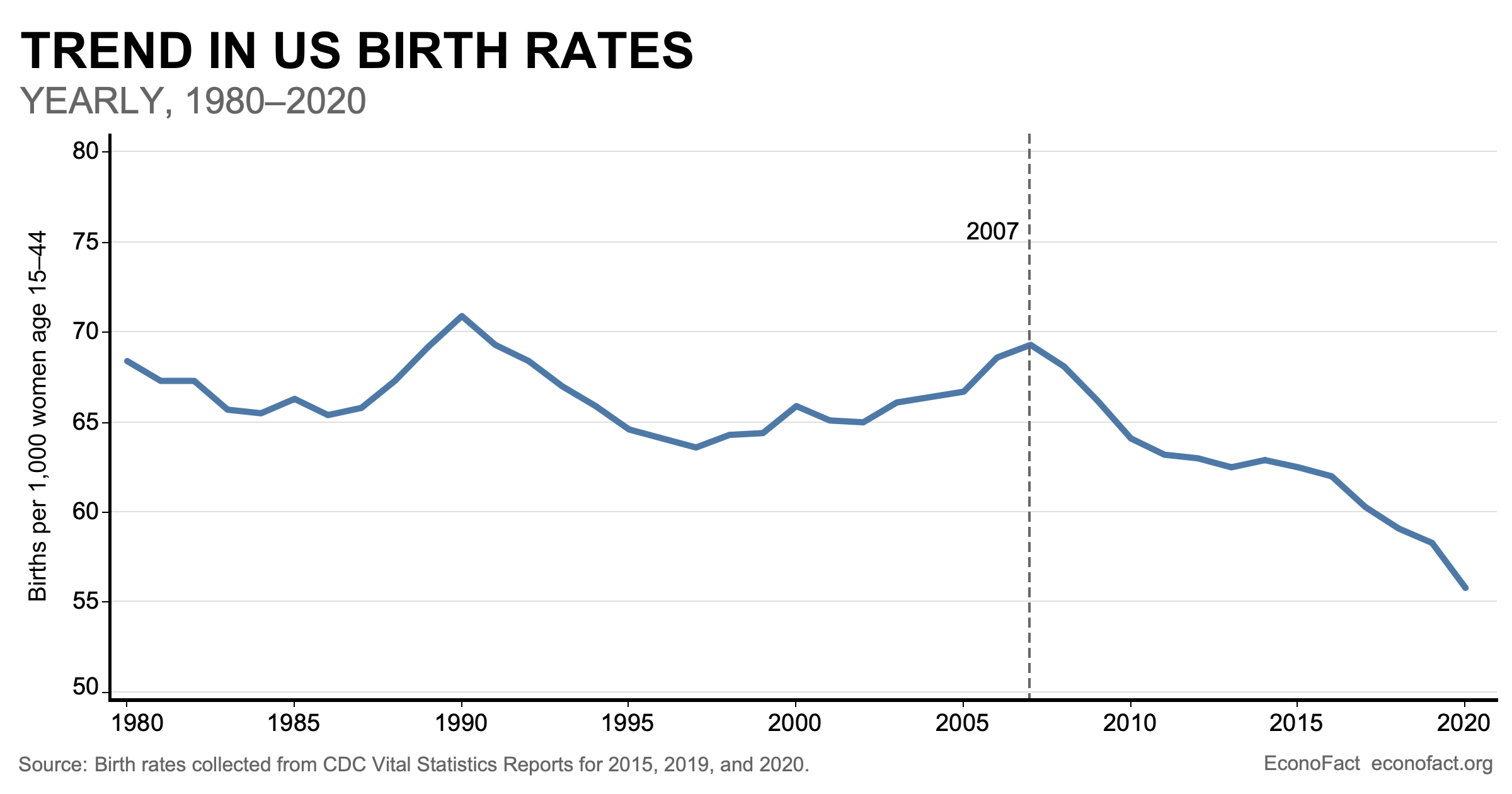
If the United States was capable of mustering even a modicum of political sense, that might suggest embracing immigration to offset the predictable decline in the domestic population prompted by declining birth rates—but that might expect too much of a place whose ignorance is its defining characteristic.
A welcome conclusion, decades after the fact
I wholeheartedly embrace the colorful conclusion that the Guardian’s editors eventually reach:
Alongside China taking Taiwan and Russia wanting the Baltics, “the US pulls an argument out of a hat to raise random hell” must be added to the world’s risk premium.
What prompted me to write this reflection was the recognition that, had Europe woken up and smelled the proverbial coffee at any point in the recent past, the unfolding nightmare of the future could have been led in a different direction.
Instead, Europe continued to enable the United States and its international belligerence not only through the era of its imperial wars on Iraq, Nicaragua, Vietnam, and dozens of other countries, but even in the latest wars on Iran, Venezuela, and Cuba.
It’s encouraging to see so many European countries finally stand up to Washington by denying Trump’s repeated request to sacrifice their own navies in a futile effort to open the strait of Hormuz.
Yet the U.K. remains an international outlier, still largely enabling a criminal president despite documentation of his corruption, international belligerence, and pedophilia.
The sooner the rest of the world figures out which side the United States is on—neither theirs, nor anyone else’s, except for an international terrorist leading the state of Israel—the sooner we might all might actually have a chance to experience the peace that the Guardian’s editors imagine in the past.
One might hope that the international press would maintain the independence that US journalists have been institutionally forced to abandon.
That, however, might be like hoping for change while enabling the same corrupt political parties to continue placing the interests of oligarchs before those of working families around the world.
@Lukas Unger calls The Guardian “Bourgeois media” to which I wholeheartedly agree: just because it’s not as bad as CNN, MS Now, Fox, OANN, Newsmax, The Economist, The Atlantic, Salon, Slate, and various other rich, white, and smug know-it-all elite perspective degree outfits, doesn’t mean it isn’t also bad.
It claims to be so pre-eminently Left leaning but drips with contempt and disdain just like the legacy media elite and they are foolish enough not to realize the partisanship of different US states as well as the differences in running in different places, for one thing, but also to run with smears on people’s character or assumptions without careful analysis first of a person’s actions vs their groupthink too or what may be the reality.
Also, they downplayed the genocide in Gaza several times prior, too.
The Guardian has been MI6 light for years. Stating a couple of obvious facts about the US and Trump in an editorial is meaningless, especially compared to their daily lies and falsehoods.